
Have you ever thought about traveling abroad and seeing the world, and perhaps even got a passport made for that purpose? Well, hold on—a passport alone isn’t enough to travel to a foreign country, especially from India; you will also need a visa. A visa?
What is a visa?
A visa is an official authorization issued by a country that permits a foreign national to enter, stay in, leave, or transit through that country for a specific purpose and duration.
Think of it this way:
Passport = A document proving your identity and citizenship.
Visa = Permission to travel to another country subject to certain conditions.
Example
If you are an Indian citizen and wish to visit the United States for tourism, you will need the following:
A valid passport issued by India and a tourist visa issued by the US government.
Without the necessary visa, you will not be permitted to board your flight or enter the country, regardless of your destination.
What kind of information does a visa contain that makes it so important?
A visa typically contains the following information:
Number of permitted entries
Why do countries require visas?
- Your name
- Passport number
- Visa type (tourist, business, student, etc.)
- Validity period
- Duration of stay
- Countries use visas for the following purposes:
- Immigration control
- Verifying the identity of travelers
- Enhancing security
- Managing tourism and employment
- Ensuring that visitors meet entry requirements
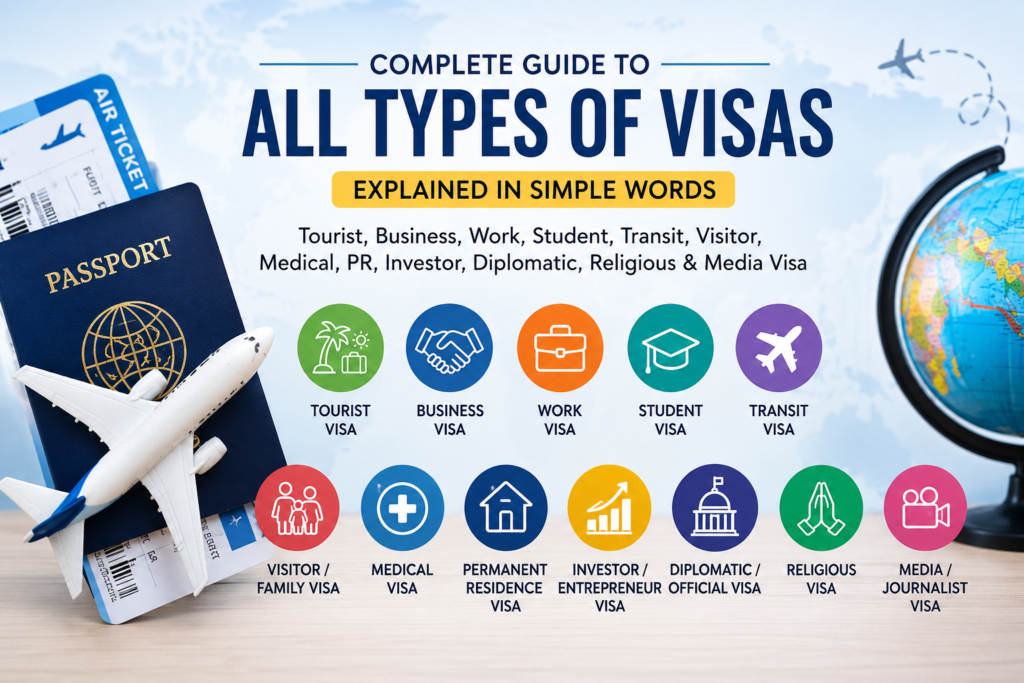
There are various types of travel visas, but generally, they are classified into these main categories:
| Visa Type | Purpose |
| Tourist Visa | Vacation, sightseeing |
| Business Visa | Meetings, conferences |
| Student Visa | Education |
| Work Visa | Employment |
| Medical Visa | Medical treatment |
| Transit Visa | Passing through a country |
| Family/Visitor Visa | Visiting relatives |
Lets know these about deeply
1. TRAVEL VISA
This visa is for vacations, sightseeing, and visiting friends or family. Most importantly, it does not permit employment; it only allows you to travel for a specific period.
The validity of this tourist visa varies by country; there is no fixed duration applicable to all.
Here are a few examples:
Thailand tourist visa: Usually 60 days
United Arab Emirates tourist visa: Usually 30 or 60 days
United States tourist visa (B1/B2): The visa itself may be valid for several years, but permission to stay is usually granted for up to 6 months per visit.
Important Distinction
Visa Validity ≠ Duration of Stay
For example:
Visa validity = 5 years
Permitted stay per visit = 90 days
This means you can use the visa for up to 5 years, but you can stay for only 90 days at a time.
2. BUSINESS VISA
For business meetings, conferences, discussions, and business-related activities.
Generally, this visa does not permit full-time employment. A business visa is issued to individuals traveling to another country for business-related purposes, such as:
Business meetings
Conferences and seminars
Trade fairs and exhibitions
Client meetings
Market research
Contract negotiations
⚠️ Typically, a business visa does not allow you to take up regular employment or receive a salary from a company in that country.
Business Visa Validity
Validity depends on the country and the type of visa:
Type Typical Validity
Short-term business visa 30–90 days
Multiple-entry business visa 6 months–5 years
Long-term business visa 1–10 years (depending on the country)
Examples
United Arab Emirates (UAE): Often 30 or 60 days.
Singapore: Usually allows for short business trips, often up to 30 days per entry.
United States (USA) B1 Business Visa: The visa can be valid for several years, but the duration of each visit usually depends on the immigration officer’s approval.
United Kingdom (UK) Standard Business Visitor Route: Usually allows for short business trips, often up to 6 months.
Commonly Required Documents
- Valid passport
- Visa application form
- Passport-sized photograph
- Invitation letter from the company abroad
- Company letter from your employer/business
- Travel plan (itinerary)
- Hotel booking (if applicable)
- Bank statements
- Proof of business purpose
Business Visa vs. Work Visa
Business Visa Work Visa
Meetings and business-related tasks Employment and receiving a salary
Short-term stay Long-term stay
No local salary Local salary permitted
Employment contract not required Job offer/sponsorship usually required
3. WORK VISA
These visas are generally for individuals employed by a company in the destination country.
They often require a job offer and sponsorship.
A work visa is a visa that allows a foreign national to work legally in another country. Unlike a tourist or business visa, a work visa permits you to hold a job and earn a salary in the country you are visiting.
Who needs a work visa?
If you:
Receive a job offer from a foreign company, plan to work abroad for a specific employer, or wish to earn an income in another country…
…then you will generally need a work visa (or work permit).
Work visa validity
Work visa validity varies depending on the country and the employment contract:
**Type | Typical Validity**
Temporary Work Visa | 6 months – 2 years
Long-term Work Visa | 2–5 years
Renewable Work Visa | Can be extended during employment
**Common Requirements**
- Valid passport
- Job offer letter
- Employment contract
- Educational certificates
- Work experience documents
- Medical examination (in some countries)
- Police clearance certificate (sometimes)
- Employer sponsorship (often required)
**Examples**
United Arab Emirates (UAE): Work visas are generally linked to the employer and a residence permit.
Canada: Many work permits are employer-specific and can be valid for several years.
Australia: There are various skilled-worker visa pathways with varying durations.
Germany: Skilled workers can obtain work/residence permits based on employment.
**Work Visa vs. Tourist Visa**
**Work Visa | Tourist Visa**
Permission to work | No permission to work
Can receive a salary | Cannot receive a salary
Job offer often required | No job offer required
Longer validity | Generally for short stays
**Can a work visa lead to permanent residency?**
In many countries, yes. After working legally for a few years, you may become eligible for permanent residency and, subsequently, citizenship, depending on the country’s immigration regulations.
4. STUDENT VISA
After work visas, student visas are the most frequently issued type of visa.
They are intended for studying at a school, college, or university.
Depending on the country, you may be permitted to work part-time.
Student visas are issued to foreign students who wish to study at a school, college, university, or recognized educational institution in another country.
Who can apply for a student visa?
Generally, you need the following:
An admission or offer letter from an educational institution
A valid passport
Proof of sufficient funds
Academic records
A visa application and necessary documents
Student visa validity
Its validity usually depends on the duration of your course.
| Course Duration | Typical Visa Validity |
| 6 months course | Around 6–12 months |
| 1 year course | Around 1–2 years |
| 3–4 year degree | Duration of the degree program |
| Master’s program | Duration of the program |
Many countries offer the option to extend the visa duration if your studies continue.
Some benefits of a student visa:
✅ Studying legally in the country
✅ Accessing educational facilities
✅ Permission to work part-time for a limited period in some countries
✅ Possibility of obtaining post-study work permits in some countries
Commonly required documents:
- Valid passport
- Admission letter from the institution
- Academic certificates and transcripts
- Proof of funds/bank statements
- Passport-sized photographs
- Medical examination (if required)
- Visa application form
- English proficiency test scores (e.g., IELTS, TOEFL), if required
Examples
Canada Student Permit: Generally valid for the duration of the study program plus some additional time after completion.
Australia Student Visa: Generally valid for the duration of the course.
US Student Visas: Linked to enrollment and academic status.
UK Student Visas: Generally cover the course duration and may include additional time before or after the studies.
Student Visa vs. Work Visa
Student Visa Work Visa
Purpose is education Purpose is employment
Requires an admission letter Requires a job offer (often)
Limited work rights Full work rights as permitted
Linked to the course duration Linked to the employment period
After graduation
Many countries offer post-study work opportunities, allowing graduates to stay and work there for a certain period after completing their studies.
5. TRANSIT VISA
This visa is somewhat different; it is not for staying or sightseeing, but specifically for travelers passing through a country while en route to another destination.
It is generally valid for a short duration.
A transit visa is a short-term visa that allows a traveler to pass through a country while traveling to another location.
For example:
India → Dubai → Canada
If you have a long layover in Dubai before your connecting flight to Canada, or if you need to leave the airport, you might require a transit visa depending on the country’s regulations and your citizenship.
Purpose of a transit visa:
- Changing flights in another country
- Passing through a country via air, sea, or land routes
- Staying briefly during a layover
Validity
Transit visas are usually valid for a very short period:
Type Typical Validity
Airport transit visa A few hours up to 24 hours
Short transit visa 24–72 hours
Extended transit visa Up to 7 days (in some countries)
General requirements:
- Valid passport
- Confirmed ticket for onward travel
- Visa for the final destination (if required)
- Proof of travel itinerary
Example
Suppose you are traveling:
India → Turkey → Germany
If your flight stops in Turkey and you need to leave the airport before your next flight, you might require a transit visa, depending on the transit rules applicable to your situation.
Transit Visa vs. Tourist Visa
Transit Visa Tourist Visa
For passing through a country For visiting/touring a country
Valid for a very short duration Valid for a longer duration
Onward travel is required Onward travel is not required
Limited activities Permission for tourism-related activities
Important Note
Many airports allow airside transit (staying within the international transit area) without a transit visa; however, the rules depend on the country, your citizenship, the airport, and whether you need to collect baggage or change terminals.
6. VISITOR / FAMILY VISA
This visa is for visiting relatives or friends.
An invitation letter from the host may be required.
A visitor visa (also known as a family visit visa in some countries) allows you to travel to another country to:
Meet family members
Visit relatives or friends
Attend family events like weddings
Spend time with loved ones
⚠️ Working or conducting business is not permitted on a visitor/family visa.
Validity
Validity depends on the country:
Type Typical permitted stay
Short-term visitor visa 30–90 days
Standard visitor visa Up to 6 months
Multiple-entry visitor visa 1–10 years validity, with a specific stay limit per visit
Commonly Required Documents
- Valid passport
- Visa application form
- Passport-sized photograph
- Invitation letter from the family member/friend
- Proof of relationship (if visiting relatives)
- Bank statements
- Travel plan (itinerary)
- Accommodation details
Example Scenarios
✅ Visiting your brother in Canada
✅ Attending a cousin’s wedding in Australia
✅ Spending a holiday with family in the United Kingdom
Visitor Visa vs. Tourist Visa
Visitor Visa Tourist Visa
Visiting family/friends Sightseeing and tourism
Invitation letter often required Invitation usually not required
Proof of relationship may be required Proof of relationship is not required
No work authorization No work authorization
Processing time
Typically takes:
1–4 weeks for many countries
It may take longer during peak travel seasons or if additional checks are required
7. MEDICAL VISA
This visa is used for undergoing medical treatment abroad.
Documentation from a recognized hospital is often required.
A medical visa is issued to individuals who need to travel to another country for treatment, surgery, specialized healthcare, or medical consultations.
Who can apply?
You can apply for a medical visa if:
You require treatment that is not available in your home country.
You are traveling for surgery or specialized care.
You wish to undergo treatment at a recognized hospital abroad.
Medical Visa Validity
Validity depends on the treatment plan and the regulations of the destination country.
Type Typical Validity
Short-term treatment 30–90 days
Long-term treatment 3–6 months
Long-term medical care Extendable as needed
Commonly Required Documents
- Valid passport
- Visa application form
- Medical records/reports
- Letter from the hospital or doctor abroad
- Proof of sufficient funds
- Travel itinerary
- Recent photograph
- Medical Attendant Visa
Many countries also issue visas for family members or caregivers accompanying the patient.
For example
✅ Cancer treatment in India
✅ Specialized surgery in Germany
✅ Advanced medical treatment in Singapore
8.IMMIGRATION PARMANNENT VISA
These visas are for individuals planning to settle permanently in another country.
They can lead to permanent residency or citizenship.
A Permanent Residence (PR) visa is an immigration status that allows a foreign national to live, work, and study in another country permanently or indefinitely, without becoming a citizen of that country.
What rights do PR holders have?
✅ Living in the country permanently
✅ Working for almost any employer
✅ Studying at schools and universities
✅ Accessing various public services and benefits
✅ Sponsoring eligible family members (subject to the country’s regulations)
Validity
This generally involves two aspects:
Status Typical Validity
PR Status Permanent (provided conditions continue to be met)
PR Card/Document Often 5–10 years; renewable
For example, your PR card may expire and require renewal, but your permanent resident status can remain intact as long as you continue to meet the residency requirements.
Common ways to obtain PR
- Skilled worker immigration
- In-country work experience
- Family sponsorship
- Investment/Entrepreneur programs
- Marriage to a citizen or permanent resident (subject to regulations)
- Refugee or humanitarian programs
Popular countries offering a path to PR - Canada
- Australia
- New Zealand
- Germany
- United Kingdom (via settlement routes)
PR vs. Citizenship
Permanent Residence Citizenship
Can live and work indefinitely Full legal membership of the country
Generally cannot vote in national elections Can vote
Retain original passport Can obtain the country’s passport (if eligible)
PR status can be lost if residency requirements aren’t met Citizenship is generally more secure
Example
Suppose you move from India to Canada on a work permit. After meeting eligibility criteria and living there for a certain period, you may qualify for permanent residence. Later, you may become eligible to apply for Canadian citizenship.
Processing time
PR applications typically take: From a few months to a few years Depending on the country, immigration category, and applicant profile.
9. INVESTER VISA
These visas are for individuals intending to invest or start a business in their destination country. Investor visas or entrepreneur visas are designed for those who:
Wish to invest capital in another country’s economy.
Want to start, acquire, or expand a business abroad.
Aim to create jobs and contribute to economic growth.
Investor Visa 💰
This visa is for individuals who invest a significant amount of capital in a country’s businesses, government-approved projects, or economy.
Examples:
- Investing in a company.
- Opening a branch of an existing business.
- Making a required investment under a government program.
- Entrepreneur Visa 🚀
This visa is for individuals who wish to start or operate a business in another country.
Examples:
- Launching a startup.
- Opening a restaurant, store, or IT company.
- Expanding an existing business internationally.
Typical Validity
Visa Type Typical Initial Validity
Investor Visa 1–5 years
Entrepreneur Visa 1–3 years
Renewable Investor/Entrepreneur Visa Often extendable
General Requirements
- ✅ Valid passport
- ✅ Business plan
- ✅ Proof of investment funds
- ✅ Financial records
- ✅ Business registration documents (if applicable)
- ✅ Proof that the business will generate jobs or economic benefits
Popular Countries with Investor/Entrepreneur Programs
- Canada
- Australia
- United Kingdom
- Portugal
- New Zealand
- United Arab Emirates
Benefits
- Opportunity to live and run a business abroad.
- Potential pathway to Permanent Residency (PR).
- Opportunity to bring eligible family members along.
- Access to international markets.
10. DIPLOMATIC OR OFFICIALS VISA
These visas are for government officials, diplomats, and representatives traveling on official business.
A diplomatic or official visa is a special type of visa issued to:
Diplomats
Ambassadors
Consular officers
Government ministers
Government officials traveling for official work
Representatives of international organizations
These visas are used solely for official duties, not for tourism, education, or private employment.
Who is eligible?
For example:
- Ambassadors
- Embassy staff
- Ministry of External Affairs officials
- Government representatives attending international meetings
- Heads of State and government officials on official assignments
Validity
There is no globally fixed validity period for these visas.
Generally:
They remain valid for the duration of the official assignment.
For short official trips, they may be valid for a few days or months.
For long-term diplomatic postings, they may remain valid for several years.
Benefits
- Depending on international agreements and the host country, holders may receive:
- Expedited immigration processing
- Exemption from visa fees
- Diplomatic privileges and immunity
- Special treatment at airports and border crossings
India issues the following:
Blue passport – Ordinary citizens
White passport – Government officials on official duty
Red (Diplomatic) passport – Diplomats and certain senior government representatives
Can ordinary citizens apply for this?
❌ No. Diplomatic and official visas are generally issued only to authorized government representatives traveling on behalf of their government. They are not granted for tourism, business, private employment, or educational purposes.
So, if you are exploring visa categories, the following are the main types:
11. RELIGIOUS VISA
These visas are for participating in religious activities, missionary work, or religious organizations.
Religious visas are issued to individuals traveling to another country for religious activities, religious service, missionary work, worship, preaching, or to work with a religious organization.
Who is eligible?
- Priests
- Pastors
- Maulanas/Imams
- Sadhus/Saints/Monks
- Missionary workers
- Religious teachers
- Members of recognized religious organizations
Validity
- Varies by country:
- Type Typical Validity
- Short-term religious visit 30–90 days
- Religious work/mission 6 months–2 years
- Long-term religious service 2–5 years or more
- In some countries, it can also be renewed.
Required Documents
- ✅ Valid passport
- ✅ Invitation letter from the religious organization
- ✅ Proof of the organization’s registration/recognition
- ✅ Travel and accommodation details
- ✅ Proof of financial means
Examples
• Travel to Saudi Arabia on a special religious visa for Hajj or Umrah.
• Religious visa to serve at a church, temple, mosque, or religious organization.
12. JOURNALIST & MEDIA VISA
This visa is for reporters, filmmakers, and media professionals covering events.
A media visa (also known as a journalist visa in many countries) is issued to journalists, reporters, photographers, documentary filmmakers, TV crews, and other media professionals traveling to another country for professional media-related work.
Who can apply?
✅ Newspaper journalists
✅ TV reporters and news anchors
✅ Documentary filmmakers
✅ Photojournalists
✅ Foreign media correspondents
✅ Camera crews and media production teams working on news or current affairs content
Purpose of a media visa
- Covering news events
- Conducting interviews
- Making documentaries
- Reporting on politics, sports, business, or cultural events
- Working abroad for a recognized media organization
Validity (Duration)
Validity varies depending on the country and the assignment:
Type Typical Validity
Short news coverage 30–90 days
Documentary project Several months
Foreign correspondent assignment 1 year or more
Some countries allow for an extension if the media assignment continues.
Commonly required documents
- Valid passport
- Journalist/Press ID card
- Letter from the media organization
- Assignment letter stating the purpose of travel
- Visa application form
- Travel plan (itinerary)
- Proof of accommodation
Example
If an Indian journalist travels to the US to report on an international event for a news channel, they may require a journalist/media visa instead of a tourist visa. Media Visa vs. Tourist Visa
- Media Visa Tourist Visa
- Allows professional media work Does not allow media reporting
- Requires media credentials Does not require media credentials
- Assignment letter required Not required
- For journalism/documentary work For tourism and sightseeing
- For YouTubers
If a YouTuber is traveling solely to create vlogs as a tourist, many countries may allow entry under standard visitor regulations. However, if the trip involves activities such as professional filming, commercial production, interviews, or reporting, a specific media permit or media visa may be required, depending on the country. Rules vary significantly by destination. ✈️🎥
Generally, this is the final major specialized visa category, following tourist, business, work, student, transit, visitor, medical, PR, investor, diplomatic, and religious visas. 🌍
Types of visa based on entry permitted
- Single-entry visa – one-time entry into the country.
- Double-entry visa – Entry twice during validity.
- Multiple-entry visa – Multiple entry during validity.
Types of visas based on format
- Sticker Visa – Physical visa affixed to the passport.
- E-Visa – applied for and issued online.
- Visa on Arrival (VoA) – Available on arrival in the destination country.
CONCLUSION
Navigating the world of visas can seem overwhelming, but understanding the specific category that aligns with your purpose of travel is the key to a smooth journey. From tourist and student visas to specialized permits for business, medical care, and professional media work, each type serves a unique function in international travel. Whether you are planning a short-term vacation or a long-term relocation, always remember that visa regulations are country-specific and subject to change. Before you book your tickets, take the time to research the official requirements for your destination and citizenship, ensuring all your documentation is in order. A little preparation goes a long way in turning your travel dreams into a reality. Safe travels!